
Jobs to Inbox is a participant in the Amazon Services LLC Associates Program. When you buy through links on this page we may earn a commission, at no extra cost to you. We choose every product ourselves and we are never paid to include one. How we pick.
The New Shape of the Engineering Interview
The standard interview loop for a software engineer is longer and more fragmented than it was even five years ago. Where a candidate might once have expected a phone screen, a half-day of on-site interviews, and an offer, the modern process is a gauntlet of specialized evaluations. Many established technology firms have expanded their loops to include between five and seven distinct stages, not including the initial resume review. This inflation is a direct response to the hiring boom of recent years, where compressed timelines led to costly hiring mistakes. Now, risk aversion is the dominant force, and companies would rather let a good candidate go than make a bad hire. The result is a protracted, multi-week process that tests not only technical ability but also endurance. Candidate fatigue is a significant and predictable outcome of this structure, yet few organizations are actively working to streamline the process for the applicant's benefit.
This means that as a candidate, you must approach the interview process as a marathon, not a sprint. Each stage is a discrete filter with its own rubric, and passing one does not guarantee you have the momentum to clear the next. An excellent performance on a take-home coding challenge can be entirely negated by a mediocre performance in a system design discussion. Understanding the purpose of each stage is critical to allocating your preparation time effectively. Companies are looking for a consistently strong signal across all dimensions, from your initial conversation with a recruiter to your ability to critique a complex piece of code. The expectation is that a senior-level candidate can perform well under different forms of scrutiny, whether it’s the solitude of a coding challenge or the collaborative pressure of a pairing session. Failing to recognize this shift is a primary reason why many experienced engineers find themselves unexpectedly rejected after what they thought was a strong final round.
The High-Stakes Opening: Recruiter and Manager Calls
The initial screening calls with a recruiter and hiring manager are not mere formalities; they are scored interviews with distinct failure modes. The recruiter screen, often perceived as a simple logistics check, is the first real gate. Beyond confirming your work history and salary expectations, the recruiter is assessing your communication skills and professional demeanor. They are running a calibration check, asking themselves if your presentation aligns with the level and pay grade of the role. A common mistake is to treat this conversation dismissively, viewing the recruiter as an obstacle rather than a stakeholder. If you are curt, unclear, or seem unenthusiastic, you will be flagged as a "poor communicator" or "low intent" candidate, often leading to a quiet rejection before you ever speak to an engineer. These notes follow you through the process, coloring the perception of every subsequent interviewer.
The hiring manager call is an even more critical filter. This conversation focuses on team alignment and project-level fit. The manager is trying to answer a simple question: will adding you to the team make their job easier or harder? They are evaluating your understanding of the problem domain, your past project experience, and your ability to articulate technical concepts to a non-specialist. A frequent failure pattern for experienced engineers is to speak in abstract terms without connecting their skills to the company's specific needs. When a hiring manager asks about your experience with large-scale data processing, they don't want a textbook definition; they want to hear about a time you solved a real data pipeline problem, the trade-offs you made, and what you learned. This is also where budget realities come into play. A recruiter might provide a wide salary band, like $160,000 to $210,000, but the hiring manager often has a much tighter internal budget, perhaps capping out at $190,000. Your performance in this call directly influences their willingness to advocate for the higher end of that range, or even to seek an exception.
The Practical Coding Challenge Replaces Puzzles
The era of relying solely on abstract algorithmic puzzles on a whiteboard is fading. In its place, the practical coding challenge has become a standard early-stage filter for a majority of software engineering roles. This can take the form of a take-home project with a multi-day deadline or a timed session in a web-based coding environment. The goal is no longer just to see if you can reverse a linked list, but to evaluate how you approach a problem that resembles a small, real-world feature. These tasks often involve parsing data, calling a mock API, and producing a formatted output. The explicit goal is to simulate a slice of the day-to-day work you would actually be doing. This shift benefits candidates who are strong builders but may not spend their weekends practicing competitive programming problems.
However, the scoring for these challenges is more complex than a simple pass-fail on functionality. A typical evaluation rubric breaks down the score into four key areas: correctness, code clarity, test coverage, and the handling of edge cases. Simply producing the correct output is the minimum expectation. A senior candidate is expected to submit code that is well-structured, easy to read, and accompanied by meaningful tests. A critical mistake experienced engineers often make is over-engineering the solution. Given a two-hour task to build a simple data-parsing script, they might spend five hours architecting a perfectly scalable, containerized microservice. While technically impressive, this signals a poor understanding of scope and an inability to deliver a simple solution for a simple problem. This frequently results in a "no hire" decision, with the feedback citing "poor time management" or "failure to follow instructions," a frustrating outcome for someone who felt they went above and beyond.
Live Pairing: Your Thought Process on Display
Following an asynchronous coding challenge, the next common stage is a live pairing session. In this one-to-two-hour interview, you will collaborate with a company engineer to solve a problem in a shared development environment. This stage is designed specifically to address the shortcomings of a take-home assignment, where it is impossible to observe a candidate's thought process or collaboration style. The focus here shifts dramatically from the final product to the process itself. The interviewer is not primarily concerned with whether you can solve the problem perfectly or quickly. Instead, they are scoring you on your ability to communicate, collaborate, and respond to feedback. This is a direct test of what it would be like to work with you on a daily basis.
One of the most important and often unspoken rules of the pairing session is the test for ambiguity. The interviewer will frequently provide a problem statement that is intentionally vague or missing key requirements. A candidate who immediately dives into writing code without asking clarifying questions is almost guaranteed to fail this interview. The expectation is that you will act like a responsible engineer, probing for details about expected inputs, error handling, and performance constraints. For example, you might ask, "What should happen if the input array is empty?" or "What are the latency requirements for this function?" This demonstrates that you think before you code. A major failure mode is treating the interviewer as an adversary to be impressed rather than a collaborator to work with. Candidates who quietly struggle and refuse to ask for help are marked down for poor communication, while those who can articulate where they are stuck and discuss potential solutions receive high marks, even if they don't complete the entire task.
The Emerging AI-Assisted Pairing Session
A new and increasingly common variant of the pairing interview involves the use of an AI coding assistant. In this format, candidates are placed in a development environment equipped with a powerful code-completion tool and asked to solve a problem. This might seem like an "easy mode" interview, but its purpose is sophisticated. Companies are not testing whether you know how to use an AI tool; they know that every engineer will be using them. They are testing your ability to leverage it effectively and responsibly. The interview is designed to see if you can act as a competent human supervisor for an incredibly productive but often flawed AI partner. This is a direct response to the reality that modern software development is becoming a process of prompt engineering, code validation, and AI-powered debugging.
The scoring rubric for an AI-assisted round is entirely different from a traditional coding test. It focuses on your critical thinking and validation skills. For example, an interviewer might observe you accepting a block of code from the AI and immediately ask, "That suggestion looks plausible, but can you walk me through the potential security vulnerabilities it might introduce?" A candidate who cannot identify risks like injection attacks, improper data handling, or dependency issues will fail. The core mistake is to blindly trust the AI's output. The session is designed to test your ability to debug incorrect suggestions, to prompt the tool for better alternatives, and to integrate its useful outputs into a coherent and safe application. An engineer who simply copies and pastes what the AI generates is seen as a liability, whereas an engineer who uses the tool to accelerate their own well-structured plan is seen as a force multiplier. This interview filters for judgment, not just coding fluency.
System Design: The Senior Engineer's Crucible
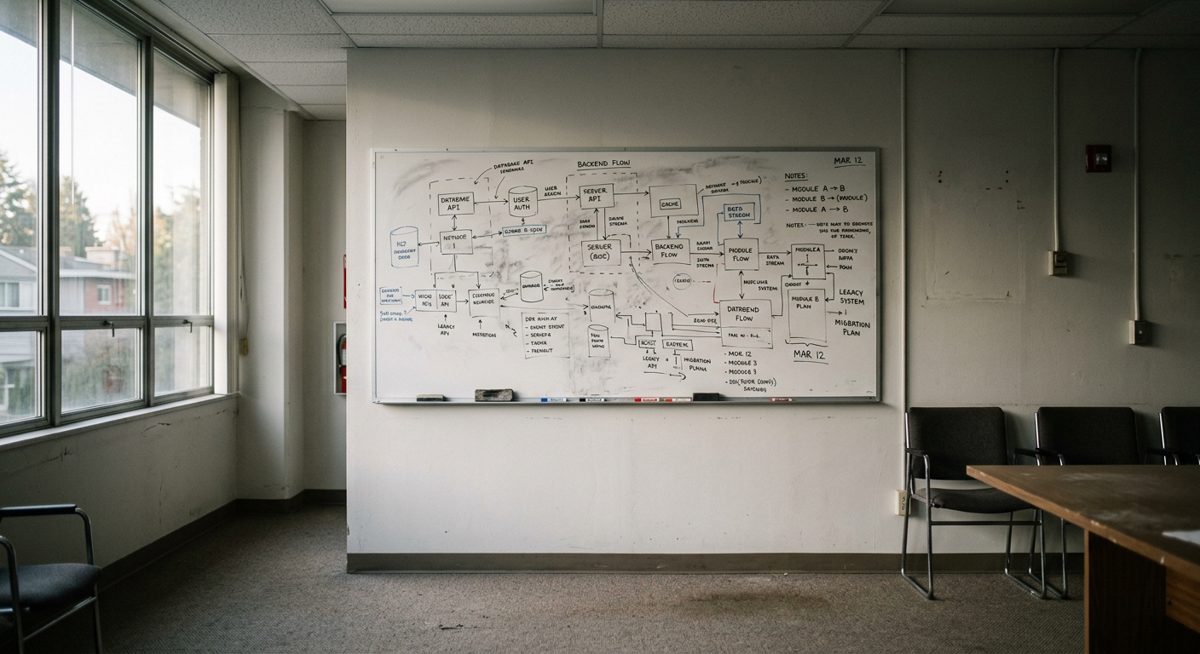
For any mid-level role and above, the system design interview is the most heavily weighted component of the entire loop. This is where you transition from writing code to architecting systems. Typically conducted on a virtual whiteboard, you are given a broad and ambiguous prompt, such as "Design a social media feed" or "Design a link-shortening service." The next hour is a structured conversation where you are expected to lead the design of a scalable, reliable, and maintainable system. This interview is less about finding a single "correct" answer and more about exploring a landscape of trade-offs. It is the primary filter used to differentiate between junior, mid-level, and senior engineering talent. A junior engineer can implement a feature, but a senior engineer is expected to design the entire system that houses it.
A frequent and fatal mistake made by experienced candidates is to jump directly to specific technologies. When faced with the prompt, they immediately declare, "I'll use a specific distributed database, a popular message queue, and a cloud-native orchestration tool." This approach completely misses the point. The interview is a test of your methodical problem-solving process. The correct approach starts with spending the first five to ten minutes rigorously defining the problem. You must ask clarifying questions about functional requirements (what should it do?) and non-functional requirements (what is the expected scale, latency, and availability?). Only after you have quantified the problem—"We need to support 10 million daily active users with a feed-load latency under 200 milliseconds"—can you begin to sketch the high-level components. The core rule is that you must drive the conversation. An interviewer who has to constantly prompt you for the next step will give you a low score for "lacks ownership" or "insufficient leadership," even if your technical suggestions are sound.
Get new remote engineering jobs sent to your inbox.
We check the employer career pages in this article every day and email you the new openings — with the real apply link, not a repost. 7,882 live right now.
Free. Unsubscribe any time.
The Code Review Interview: A Test of Your Standards
One of the most practical and telling interviews in the modern loop is the code review simulation. In this stage, you are presented with a mock pull request—a block of code submitted as a proposed change to a codebase—and are asked to review it as if you were a teammate. This is not a hypothetical exercise; the code is real and has been intentionally seeded with a wide variety of flaws. This interview is a direct test of your attention to detail, your knowledge of best practices, and, most importantly, your ability to provide constructive, actionable feedback. Companies use this to gauge your quality bar. Would you let this code into the production environment? Your answer reveals a great deal about your standards and your level of experience.
The provided code is a carefully constructed trap, containing bugs across several categories: obvious logic errors, subtle concurrency problems, potential security vulnerabilities, poor architectural patterns, and simple style violations. You are being scored on the breadth and depth of your findings. A junior candidate might only spot the inconsistent variable naming and missing comments. A senior candidate is expected to identify the race condition that will bring the system down under load or the cross-site scripting vulnerability that exposes user data. However, finding the flaws is only half the battle. The other half is how you communicate them. A common failure mode for highly experienced engineers is to be overly blunt or arrogant in their feedback. Leaving comments like "This is completely wrong" or "Why would anyone do it this way?" is a fast track to a "no hire" decision for "poor interpersonal skills." The correct approach is to frame feedback collaboratively, often as questions: "I'm wondering if there's an edge case here if the input is null. What do you think about adding a check?" This demonstrates both technical acumen and the emotional intelligence required to work effectively on a team.
Preparing for the Marathon: A Realistic Timeline
Successfully navigating the modern engineering interview loop requires a level of preparation far beyond what was necessary in the past. Treating it like a final exam that can be crammed for over a weekend is a recipe for failure, especially for senior roles at competitive firms. A realistic preparation plan for an experienced engineer targeting such a role involves a commitment of 80 to 120 hours of focused effort, typically spread over six to eight weeks. This schedule allows for deep learning and practice without leading to burnout. A rushed two-week prep schedule almost guarantees that you will be exhausted by the time you reach the final rounds, which are often the most demanding. This sustained effort is the new baseline for competing effectively in the current market.
This preparation time should be strategically allocated. A reasonable breakdown would be approximately 40 hours dedicated to hands-on, practical coding problems, another 40 hours focused on system design principles and mock interviews, and the remaining 20 hours spent on behavioral questions and refining your project stories. After the technical loop concludes, remember that the process isn't over. The interviewers convene for a debrief session to compare notes and make a collective hiring decision. In these meetings, a single "soft no" from an interviewer who found you to be a poor communicator can often veto multiple "strong yes" ratings on technical skill. Your consistency across every single stage is what ultimately secures the offer.
To begin this process, don't just dive into abstract problems. Start by applying these interview frameworks to your own work. This week, choose a project you completed in the last year. Take an hour and write a one-page system design document for it, as if you were presenting it in an interview. Explicitly state the requirements, constraints, and the trade-offs you made. Then, find a significant pull request you reviewed six months ago and review it again. Look for the deeper bugs, security issues, or architectural flaws you may have missed. The goal isn't to critique your past self, but to calibrate your eyes to the exacting standards you will be judged against in your next interview loop.
As an Amazon Associate we earn from qualifying purchases. Product availability and prices on Amazon change frequently and anything shown here may be out of date by the time you click. How we pick our recommendations.